
About the Author
Lauren Shelton
Lauren is the Tax Manager at Fine Point Consulting and has over 15 years of accounting experience.
More Insights from
Lauren Shelton


Your startup is based in Wisconsin. Your next great hire lives in Illinois. Another employee wants to move to Minnesota. Meanwhile, customers are signing up from across the country.
That is exciting growth. It is also the point when your accounting, payroll, and tax processes need to catch up with how your business actually operates.
A Wisconsin headquarters does not necessarily mean Wisconsin is the only state where your company has responsibilities. Employees, customers, property, and business activities can each raise different questions about where to register, withhold taxes, and file returns.
A thoughtful multistate startup accounting and tax strategy connects those questions before they become separate problems. Here is how Wisconsin founders and finance leaders can build one.
Multistate tax compliance is not one registration or one annual return. Review each category separately.
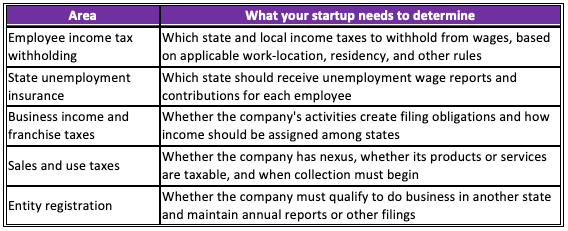
These categories can overlap, but satisfying one does not resolve the others. Treat the table as a review framework; the actual requirements depend on each state's rules and your company's facts.
State tax nexus is the connection that allows a state to impose a particular tax obligation on a business. The analysis depends on the tax involved. Wisconsin's Department of Revenue, for example, separately explains nexus for corporate income and franchise taxes and registration requirements for remote sellers.
For a growing startup, review activities such as:
These are review triggers, not a statement that every activity automatically produces every tax obligation. California, for example, evaluates doing-business status using criteria that include transactions for financial gain and certain sales, property, or payroll thresholds. Its rules illustrate why a Wisconsin company needs a state-specific assessment.
Practical takeaway: Review a new state before the activity begins whenever possible. Hiring approval should include a tax and registration check alongside salary and benefits approval.
A remote employee's mailing address is useful information, but it is not a complete payroll tax analysis. Collect both where the employee lives and where they physically perform their work.
Before adding a state to payroll, document:
Wisconsin generally requires withholding on wages earned by nonresidents for work performed in Wisconsin, subject to exceptions. When a nonresident works both inside and outside Wisconsin, the Wisconsin withholding analysis focuses on the portion earned in Wisconsin. Resident-state requirements may also need to be considered.
Do not assume that selecting a state in your payroll platform completes the process. Confirm who will obtain account numbers, supply tax rates, configure withholding, submit returns, and respond to notices. The provider's service agreement should make those responsibilities clear.
Wisconsin has income tax reciprocity agreements with Illinois, Indiana, Kentucky, and Michigan. These agreements generally allow covered employee compensation to be taxed by the employee's home state rather than the reciprocal state where they work. Required documentation and exceptions still matter.
For example, an Illinois resident who commutes to work in Wisconsin generally uses the reciprocity rules for covered wages. The employer should obtain the appropriate declaration and verify Illinois withholding requirements.
Reciprocity applies to covered employee compensation. It does not eliminate the company's separate business tax, sales tax, unemployment, or registration review. Wisconsin's guidance also distinguishes wages from self-employment income and pass-through income.
Minnesota is not on Wisconsin's reciprocity list. Wisconsin and Minnesota have separate guidance addressing withholding and potential resident credits. Do not treat a Minnesota hire or cross-border commute the same way as an Illinois arrangement.
Unemployment reporting does not necessarily follow the same result as income tax withholding. Wisconsin uses a sequence of tests for multistate employment: localization, base of operations, direction and control, and residence. The applicable facts determine which test resolves coverage.
A Wisconsin startup with someone working permanently from another state should therefore review unemployment coverage separately rather than automatically reporting everyone to Wisconsin.
“We are still losing money” is not a reliable filing strategy.
Filing requirements and the amount of tax owed are different questions. Wisconsin, for example, generally requires corporate returns from nonexempt Wisconsin corporations and identifies additional filing categories for out-of-state corporations.
What you sell can also affect where you need to file a state income tax return. Selling physical goods to customers in another state may qualify for federal protection under Public Law 86-272 if your only activity there is soliciting orders and those orders are approved and filled from outside the state. Service sales fall outside that protection and may trigger a return even if you have no office in the customer’s state. Review each state’s filing rules based on what you sell and where you do business.
Your business tax review should address:
Apportionment is the process used to assign a share of business income among taxing jurisdictions. Wisconsin's corporate guidance describes when a multistate unitary business must use apportionment. Do not assume that dividing income by employee count—or using the same percentage everywhere—will produce the correct result.
Build these questions into business tax planning before year-end, especially when hiring or customer growth changes where the company operates.
A startup can need a sales tax review in a state where it has no employees. Wisconsin's remote-seller guidance, for example, describes economic nexus based on sales into the state and separately addresses sellers with physical presence.
For each state under review, answer three questions:
Avoid applying one state's sales threshold to every other state. Also avoid assuming that every software or service sale receives the same tax treatment.
As an internal control, track sales by customer jurisdiction and offering type. Ask your advisor which customer-location fields and supporting records are needed for the applicable sourcing rules. A billing address alone may not answer every question.
Tax decisions are easier when the underlying records are complete. Your accounting system, payroll records, and employee files should provide a consistent picture of where the business operates.
Start with a central state register that records:
You do not necessarily need a complicated system. A controlled register with supporting documents can work well for an early-stage business if someone owns it and keeps it current.
At each monthly close, reconcile payroll liabilities to filings and payments, review unresolved notices, and check for location changes or new-state activity. Review sales data against the thresholds and definitions your advisor has identified.
The goal is to make multistate tax compliance part of routine financial management rather than a year-end reconstruction project.
Consider a Madison startup hiring a developer who will work entirely from Minnesota. The offer is signed, and the hiring manager is ready to send a laptop.
Before the employee starts, the company should review Minnesota payroll accounts, unemployment coverage, business tax nexus, and entity registration. It should also coordinate related employment requirements with HR and legal advisors. None of those conclusions should be based solely on the fact that headquarters are in Wisconsin.
A repeatable workflow makes this manageable:
Use the same process when a current employee requests a move. Temporary arrangements should also be reviewed; do not assume a short stay is automatically exempt.
If employees have already been working in an unreviewed state, begin by gathering the facts: first activity dates, wages, workdays, sales, property, and prior filings.
Have your advisor determine the historical obligations and appropriate correction process before choosing registration effective dates or submitting returns. Depending on the jurisdiction and circumstances, ask whether amended filings, late registrations, or a voluntary disclosure process should be evaluated.
Keep notices in one place and assign someone to track response deadlines. Forwarding a notice is only the first step; confirm who will resolve it and document the outcome.
Before entering a new state, confirm that your team has:
Repeat the review as the business changes. A conclusion made before your first remote hire may no longer fit after a new product launch, acquisition, or expansion.
Your startup's growth plan and its back-office processes should move together. Hiring in another state, adding customers, and preparing for investment all become easier to manage when accounting, payroll, HR, and tax advisors work from the same information.
Fine Point Consulting helps startups and growing businesses with accounting, HR, tax, and financial strategy. We help founders connect day-to-day financial operations with the planning needed for their next stage of growth.
Whether you are considering your first out-of-state hire or reviewing an expanding remote team, we can help you assess your current processes and identify next steps.
Let's talk about your startup's accounting and tax strategy.
This guide provides general educational information, not individualized tax or legal advice. Requirements depend on your entity, activities, locations, and applicable law. Confirm current requirements for each state before acting.
No. A Wisconsin headquarters does not mean Wisconsin is the only state where a startup has obligations. Employees, customers, property, andbusiness activities can each create separate payroll withholding, unemploymentinsurance, business income or franchise tax, sales tax, and entity registrationquestions in other states. Each category should be reviewed separately, and the answer depends on each state's rules and the company's facts.
State tax nexus is the connection that allows a state to impose a particular tax obligation on a business. The analysis depends on the tax involved, so a company may have nexus for sales tax in a state where it has no employees, or for income tax based on different activities. Common review triggers include hiring or relocating an employee, maintaining an office or inventory, sending team members to sell or provide services, and growing sales into a new state.
Wisconsin has income tax reciprocity agreements with Illinois, Indiana, Kentucky, and Michigan. These agreements generally allow covered employee wages to be taxed by the employee's home state rather than the state where they work, with required documentation and exceptions. Minnesota is noton Wisconsin's reciprocity list. Reciprocity also does not eliminate a company's separate business tax, sales tax, unemployment, or registration review.
Possibly. Filing requirements and the amount of tax owed are different questions, so operating at a loss does not automatically remove a filing obligation. For example, Wisconsin generally requires corporate returns from nonexempt Wisconsin corporations and identifies additional filing categories for out-of-state corporations. Selling services into a state, or selling goods beyond the protection of Public Law 86-272, may also trigger a return even without an office there.
Review the new state before the employee starts. Record where the employee will live and work and the effective date, then have advisors assess payroll withholding, unemployment coverage, business tax nexus, entity registration, and related employment requirements. Assign someone to obtain accounts and configure payroll, check the first payroll, and require advance notice of future moves. Temporary arrangements should be reviewed too.
Lauren is the Tax Manager at Fine Point Consulting and has over 15 years of accounting experience.
Enter your email address to sign up for our free and informative newsletter.

