
About the Author
Danny Burns
Danny is a Partner and Madison Practice Leader for Fine Point Consulting.
More Insights from
Danny Burns


You’re ready to make your next hire. But can your business comfortably afford it?
Revenue is growing. But is profitability keeping pace?
An investor asks for financial statements. Are yours ready to share?
For startup founders, questions like these can expose the limits of managing accounting between everything else. Eventually, the business needs more financial support—and a decision about how to get it.
Should you hire an in-house accountant or work with an outsourced accounting partner?
Both can be effective. The right choice depends on your workload, the expertise you need, and how closely accounting needs to operate within your business each day.
An in-house accountant is an employee dedicated to your business. You determine the role, manage their priorities, and build their responsibilities around your operations.
With outsourced accounting, an external partner handles an agreed scope of financial work. At Fine Point Consulting, that can include bookkeeping, accounts payable and receivable, payroll support, reconciliations, month-end close, financial reporting, and audit support.
The biggest distinction is the structure behind that support. An internal hire brings one person’s capabilities and capacity. An outsourced team can bring several people with different strengths.
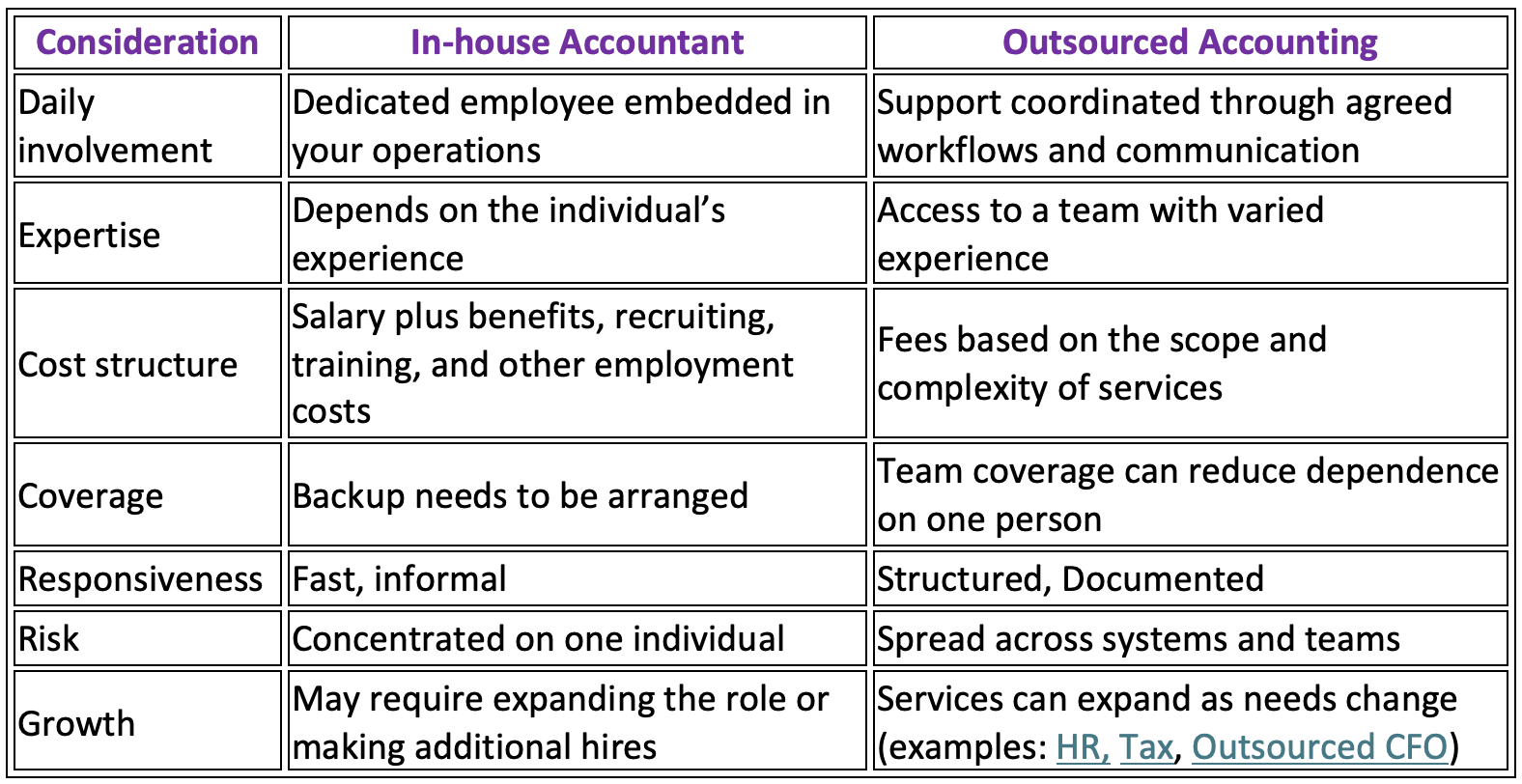
Comparing an accounting proposal with an accountant’s salary only tells part of the story.
For an internal hire, consider benefits, employer payroll taxes, recruiting, onboarding, software, and the time required to manage the position. Then ask whether that person can handle everything the business needs.
For an outsourced partner, clarify what the fee includes, what costs extra, and how pricing changes as transaction volume or complexity increases.
Outsourcing can be cost-effective when a startup needs several types of expertise but cannot yet justify a full internal accounting team, and it lets you add support as you grow instead of hiring ahead of need. As the workload grows, the economics may change.
A strong accountant can become a valuable member of your team. But a broad job description does not automatically create broad expertise.
Someone who excels at daily accounting may have less experience supporting an audit or building more sophisticated reporting. Even an experienced hire has finite time.
Fine Point’s “stacked bench” approach gives startups access to a team, shared experience, and coverage when someone is away. That structure can also support stronger review processes and clearer divisions of responsibility.
For a founder, the practical question is: Are we hiring for one well-defined role, or expecting one person to cover an entire accounting function?
Hiring internally may be a strong choice when you have enough consistent work to support a full-time position and need someone closely involved in daily operations.
Perhaps accounting requires frequent coordination with department leaders. Maybe your processes demand substantial company-specific knowledge, or your business is ready to build an internal finance team.
Before hiring, define what success looks like. What will this person own? What experience is essential? Who will review their work, and who will provide coverage?
A clear role gives both the business and the new employee a better foundation.
Outsourcing may be a good fit when financial work is pulling founders away from running the business, reporting is falling behind, you’re preparing for fundraising, or growth is creating needs beyond basic bookkeeping. Clean books, timely reporting, and a reliable month-end close make it easier to hire with confidence, talk to investors, and pass diligence or an audit without scrambling
Fine Point helps startups establish reliable financial processes and reporting, with support that can expand as the business grows. However, an outsourced relationship still requires your involvement. Someone inside the company must provide context, approve decisions, and communicate changes. Clear expectations about responsibilities, reporting deadlines, and access to the team matter from the beginning.
The decision does not have to be permanent or all-or-nothing.
A startup might hire an internal accountant to manage daily activity while retaining outside support for specific needs. Another might begin with outsourcing and add internal capacity as its workload becomes more predictable.
Whichever structure you choose, be explicit about who owns each task and who reviews the results. A hybrid approach works best when responsibilities are clear. However, you don’t have to do this alone. Our team will work alongside you to determine responsibilities and make sure we play to internal hires’ strengths.
Before deciding how to support your accounting needs, ask what you need your financial information to help you do.
Can you confidently evaluate a new hire? Understand why cash is tight? Explain performance to investors? Identify which parts of the business are profitable?
Those answers should guide the support you choose.
At Fine Point Consulting, we help startups build an accounting foundation that supports their next stage of growth. Whether you need help getting financial processes in order or more dependable reporting, our team can help you understand what support makes sense.
Ready to explore your options? Learn more about Fine Point’s accounting services, or visit our FAQ resource center for answers to common startup accounting questions.
Danny is a Partner and Madison Practice Leader for Fine Point Consulting.
Enter your email address to sign up for our free and informative newsletter.

